
Learning about your personal heritage can move you to a better understanding of who you are and where you came from. In some cases this encourages you on the path that you are on, but other times it helps stir you to action and to carry the mantle of what once was. During my recent trip to Turkey we visited five sites that helped me better understand the spiritual state of Turkey: a port, a palace, ancient tombs, a decorated mosque, and the home of a follower of Jesus.
1. The Port of Antioch

In visiting the ancient biblical city of Antioch, we got to go to the port where Paul and Barnabas would have left for their first missionary journey. This held great significance, not because we consider the Apostle Paul to be the greatest missionary of all time, but for me it was the church at Antioch that sent him out to do the work…The church of Antioch is described in Act 11: 19-26 as the first area where followers of Jesus who fled persecution preached about Jesus to Hellenists and would come to be called Christians for the first time:
19Now those who were scattered because of the persecution that arose over Stephen traveled as far as Phoenicia and Cyprus and Antioch, speaking the word to no one except Jews. 20But there were some of them, men of Cyprus and Cyrene, who on coming to Antioch spoke to the Hellenists also, preaching the Lord Jesus. 21And the hand of the Lord was with them, and a great number who believed turned to the Lord. 22The report of this came to the ears of the church in Jerusalem, and they sent Barnabas to Antioch. 23When he came and saw the grace of God, he was glad, and he exhorted them all to remain faithful to the Lord with steadfast purpose, 24for he was a good man, full of the Holy Spirit and of faith. And a great many people were added to the Lord. 25So Barnabas went to Tarsus to look for Saul, 26and when he had found him, he brought him to Antioch. For a whole year they met with the church and taught a great many people. And in Antioch the disciples were first called Christians. (ESV)
In addition to the being the first church to preach Jesus to the Hellenists and the first place where the disciples were called Christians, they also send out Paul and Barnabas for their first missionary journey, as seen in Acts 13:2-3
2While they were worshiping the Lord and fasting, the Holy Spirit said, “Set apart for me Barnabas and Saul for the work to which I have called them.” 3Then after fasting and praying they laid their hands on them and sent them off. (ESV)
To walk where Paul walked, as he was leaving for his first missionary journey, on my first vision trip as a Catalyst working with unengaged people groups was a very powerful and encouraging moment for me personally. It was something that I will not forget. He was a champion of preaching to the gentiles of which I am! The way that he and the other apostles did what Jesus modeled had an impact almost 2000 years ago that resulted in a network of people coming to know Jesus that would trickle down through generations and God would use to bring about my salvation. And Paul left on that first journey in faith right there. God could use us to continue to pass that down through generations to see Matthew 24:12 fulfill as all nations will hear the testimony of His gospel, and then the end will come.
The church at Antioch took up that call and took ownership of fulfilling the Great Commission in reaching gentiles where they live and sending Paul and Barnabas to help reach the nations, but as generations would pass, and regimes would rise and fall, this call was not passed down and there are a mere 25 believers in Antioch now.
2. The Topkapi Palace

As the Ottoman Empire took over the region, Islam almost wiped out Christianity as people were given the opportunity to pay high taxes, convert to Islam, or be killed. During our seven hour layover in Istanbul, we took a trip to Old City to see some of the historic sites. The Topkapi Palace was built in the mid-to-late 1400s by Mehmed as the Ottoman Empire took over Istanbul. The Topkapi Palace was the administrative, educational, and art center for the empire for nearly 400 years.1
As we walked throughout the palace and go to see the architecture, upkeep of the grounds, views of the city and the sea, and walk through the museums I began to feel a spiritual weight on me as we read and learned more about the takeover of the Ottomans and the political and financial oppression of Christians and Jews throughout the once Byzantium claimed territory. Artifacts within the museums at the palace included many weapons used against the Byzantium Empire throughout the Crusades and even the different sacks of Istanbul and the surrounding areas.
Christians and Jews were tolerated because of Islam’s recognition of Abraham, Moses, and Jesus as prophets, but they had higher taxes, poll taxes, and were limited in their occupation because all government jobs were to be held by muslims.2 This would eventually lead to generational creep away from Christianity and an even greater celebration of Islam from the political leaders.
3. Tombs in Antioch
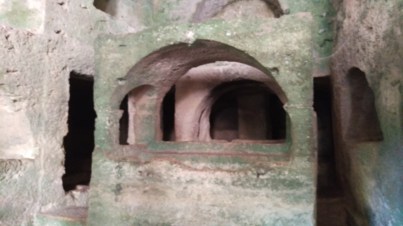 During our trip to the port of Antioch, we took a detour to see some ancient tombs that have been empty for years. This made me think of the spiritual state of Turkey. The Turks as a people group are considered to be the unreached people group with the largest population in the world. The people who live in what was considered Asia Minor, where Paul proclaimed in a two year journey that everyone had heard the gospel, now have a less than 2% population of Christians. While I have no clue who laid in these tombs, I felt as if this represented the church of Antioch of the past.
4. The Sophia Mosque
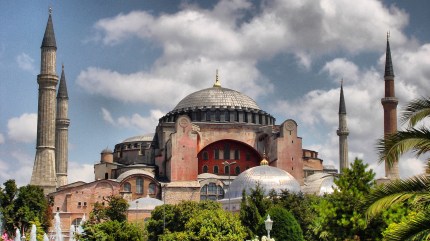 Built by Constantine II of the Byzantine Empire as the largest Church in the sixth century, the Hagia Sophia was to be the biggest church in the world. After the Ottoman take over of Istanbul in the 1400s, it was turned into a mosque. Some of the paintings were changed, and large
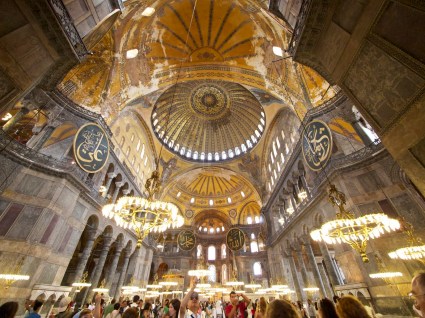 12 foot diameter tablets
with Islamic calligraphy were hoisted into their current place. This is celebrated as a mosque that has been secularized as a tourist spot now. There is one hallway that talks about the construction of the Hagia Sophia as a Christian church, but other than that it is celebrated and commemorated as the Sophia Mosque and people can learn about the historical significance that it played.
In America we are starting to relate to some of this as we see Mosques go up in areas that held significant to us for something else once upon a time, but it is still hard for me to imagine being a believer and going to the Hagia Sophia for service, but then it being converted into a mosque. What destruction I would feel for my faith! This was all the more a sign for me not to consider a building as ‘The Church’ and a reminder that followers of Jesus are ‘The Church’.
5.Family of Jesus Followers Home
While in this home we got to hear how the man, an automobile mechanic shares Jesus’ story with people at his job. The family even had an evangecube under their TV so that they could share Jesus’ story with anyone who came over.
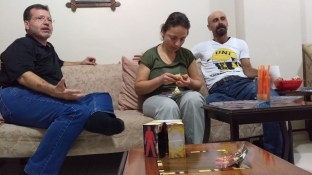
We got to hear this family say that they looked for people who were not close to their family to share with. The idea behind this thought is that they will not fear their family being upset with them for starting to follow Jesus. In the states this is something that we often do, looking for the person who is an outsider…we sometimes view them as having less to overcome to start following Jesus…they must be desperate and searching. There is indeed some truth to this, but in a muslim culture we encouraged them to try to gather the family together to hear stories about Jesus so that they could talk through and make those decisions together. We are hearing that in situations where this takes place that they are more encouraged for their new walk with Jesus.
The family was open to this approach, the same way that many Sunnis and Alawites that we encountered were open to hearing stories about Jesus. Jesus is a prophet to them in their Quran and therefore we ever heard some of them tell us that they love Jesus.
I did not realize how much Islam has a hold on Turkey, but upon coming to grasp that I also came to see that the people are open to hearing stories about Jesus. I was again reminded about how you get a favorable response when you ask people to gather to hear a story about Jesus and continue to invest in them, loving them as Jesus would. Could this approach help restore millions of Turks to the faith of generations past? Please join with me in praying that it does.
Sources:
 Hold on Holders